
Did you know that organizations waste an average of 20-30% of their resources due to inefficient processes and operations? This staggering statistic highlights the urgent need for implementing Lean tools and techniques to eliminate waste, optimize productivity, and achieve operational excellence.
Lean management principles and methodologies, rooted in continuous improvement, provide organizations with a systematic approach to enhance their operations. By leveraging Lean manufacturing tools, such as 5S methodology, Kaizen techniques, value stream mapping, Kanban systems, and more, organizations can drive efficiency, reduce costs, and deliver value to their customers.
Key Takeaways:
- Lean tools and techniques help organizations eliminate waste, optimize processes, and enhance productivity.
- The 5S methodology promotes a clean and efficient work environment for improved workflow and employee efficiency.
- Kaizen techniques foster a culture of continuous improvement by engaging employees at all levels.
- Value stream mapping provides insights into process inefficiencies, enabling targeted improvements.
- The Kanban system regulates workflow, reducing inventory waste and optimizing resource utilization.
5S Methodology: Organizing the Work Area
The 5S methodology is a powerful Lean tool that focuses on work area organization, promoting a clean and efficient environment. By following a systematic approach, organizations can eliminate waste, improve productivity, and enhance overall efficiency.
Five Steps of the 5S Methodology
- Sort: In this step, you identify and eliminate unnecessary items in the work area. By separating essential items from the non-essential, you create a clutter-free environment that facilitates easy access to tools and materials.
- Straighten: Once you have sorted out the essential items, the next step is to arrange them in a logical and organized manner. This includes labeling, assigning dedicated storage locations, and implementing visual cues to indicate where items should be placed.
- Shine: Regular cleaning and maintenance are vital for sustaining an organized work area. This step involves deep cleaning and inspecting the work area, ensuring that it is free from dirt, dust, and debris. A clean and well-maintained work area promotes safety, efficiency, and pride in the workplace.
- Standardize: Establishing standards and guidelines is crucial for maintaining consistency and sustainability. By documenting the established practices for organization and cleanliness, you ensure that everyone follows the same procedures, leading to a standardized work environment.
- Sustain: The final step of the 5S methodology focuses on creating a culture of continuous improvement. Sustaining the improvements made in the previous steps requires ongoing commitment and regular audits. By encouraging employee involvement and providing necessary resources, you can ensure that the work area remains organized and efficient in the long run.
Implementing the 5S methodology brings numerous benefits to organizations. It enables employees to work in a clean and well-organized environment, reducing distractions and improving focus. Easy access to tools and materials saves time and minimizes the risk of errors. Additionally, an organized work area enhances safety and promotes a sense of pride and ownership among employees.
| Benefits of 5S Methodology | Explanation |
|---|---|
| Improved productivity | The streamlined work area allows employees to work efficiently and reduces time wasted searching for tools or materials. |
| Enhanced safety | A clean and organized work area reduces the risk of accidents and creates a safer working environment. |
| Increased efficiency | Eliminating clutter and implementing standardized processes improve workflow, leading to improved efficiency. |
| Reduced waste | By removing unnecessary items and optimizing processes, 5S helps eliminate waste and improve resource utilization. |
| Boosted employee morale | A clean and well-organized work area fosters a sense of pride and ownership, contributing to higher employee satisfaction. |
The 5S methodology serves as a foundation for efficient and organized workspaces, forming an essential part of Lean tools and techniques. By implementing the 5S methodology, organizations can create a productive and harmonious work environment that supports continuous improvement and drives success.
Kaizen Techniques: Continuous Improvement
Kaizen is a powerful strategy that focuses on achieving continuous improvement in the manufacturing process. By actively involving employees and encouraging incremental improvements, organizations can eliminate waste, enhance efficiency, and drive innovation. Kaizen techniques are an integral part of Lean tools and principles, enabling organizations to optimize their operations and deliver higher value to customers.
Emphasizing continuous improvement fosters a culture of innovation and encourages employees to take ownership of identifying improvement opportunities. This collaborative approach ensures that all individuals contribute their ideas, expertise, and insights towards enhancing processes and driving operational excellence.
The key to successful Kaizen implementation lies in regular communication, close collaboration, and ongoing training. By providing employees with the necessary skills and knowledge, organizations empower their workforce to actively participate in achieving continuous improvement.
A core principle of Kaizen is the notion that small, incremental changes have a significant impact on overall performance. This approach not only allows organizations to address specific process inefficiencies but also enables them to identify and eliminate waste systematically.
“Kaizen is like a stone slowly grinding the sword. Each improvement brings us closer to achieving excellence and achieving our goals.”
Implementing Kaizen techniques involves the following steps:
- Identify improvement opportunities: This step involves analyzing the current processes, identifying pain points, and determining areas that require improvement.
- Collect data: Gathering relevant data and metrics is crucial for assessing the impact of potential changes and evaluating improvement outcomes.
- Brainstorm solutions: Encourage employees to generate ideas and propose potential solutions to address the identified improvement opportunities.
- Implement changes: Test and implement the proposed solutions in a controlled manner, ensuring minimal disruption to ongoing operations.
- Evaluate effectiveness: Analyze the impact of implemented changes and assess whether the desired improvement outcomes have been achieved.
- Standardize and sustain: Document successful changes, establish new standards, and ensure that newly implemented processes are sustained over time.
The Kaizen philosophy emphasizes that continuous improvement is an ongoing journey rather than a one-time event. By embracing Kaizen techniques, organizations can foster a culture of excellence, empower their workforce, and achieve incremental improvements that drive long-term success.
Value Stream Mapping: Analyzing and Optimizing Processes
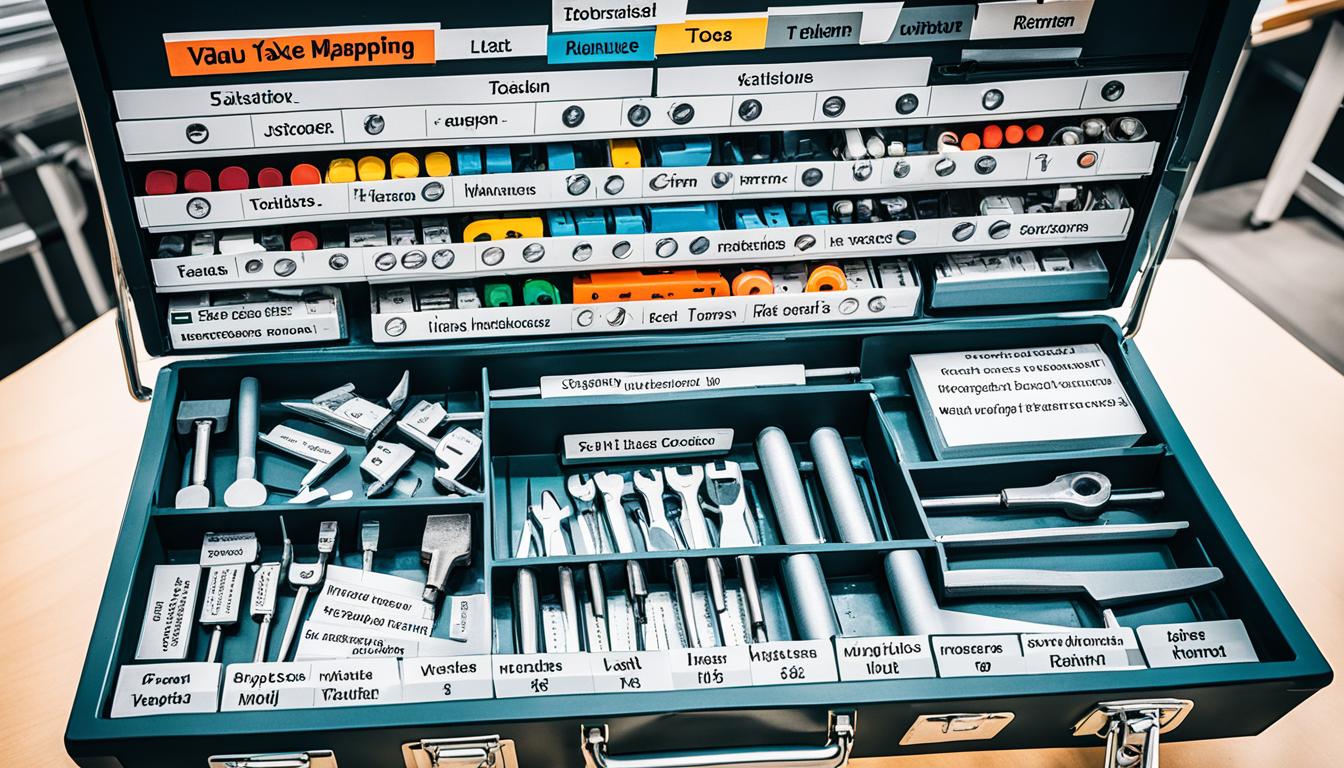
Value stream mapping is a powerful Lean tool that allows organizations to analyze and optimize their processes. By creating a visual representation of the flow of value from raw materials to the final product or service, value stream mapping helps identify inefficiencies, bottlenecks, and waste in the process.
Through a detailed analysis of the current state and the design of a future state, organizations can make targeted improvements to streamline their processes, reduce lead times, and enhance overall efficiency. Value stream mapping enables organizations to identify where value is being created and where there is room for improvement.
By using Lean tools and principles, organizations can optimize their processes, eliminate waste, and ultimately deliver greater value to their customers. Value stream mapping is a key tool in the Lean toolkit for process optimization, enabling organizations to identify areas of improvement, implement changes, and achieve higher levels of efficiency.
“Value stream mapping enables organizations to identify where value is being created and where there is room for improvement.”
Benefits of Value Stream Mapping
Value stream mapping offers several benefits to organizations:
- Identifies inefficiencies and waste in the process
- Highlights bottlenecks and areas for improvement
- Enables targeted improvements to streamline processes
- Reduces lead times and improves overall efficiency
- Enhances visibility and understanding of the entire value stream
Example Value Stream Mapping
| Process Step | Processing Time | Value-Added Time | Non-Value-Added Time |
|---|---|---|---|
| Step 1 | 2 hours | 1 hour | 1 hour |
| Step 2 | 3 hours | 2 hours | 1 hour |
| Step 3 | 4 hours | 3 hours | 1 hour |
The value stream mapping example above illustrates the processing time, value-added time, and non-value-added time for each step in a process. By analyzing this data, organizations can identify opportunities to reduce non-value-added time and streamline the overall process, leading to improved efficiency and productivity.
Value stream mapping serves as a roadmap for process optimization and continuous improvement. It enables organizations to visualize the current state, identify areas for improvement, and design a future state that enhances overall efficiency. By leveraging Lean tools like value stream mapping, organizations can achieve process excellence and deliver greater value to their customers.
Continuous Improvement Tools: Driving Innovation
Continuous improvement tools are essential for organizations seeking to drive innovation and achieve optimal efficiency. These tools, which are an integral part of Lean practices, empower employees to contribute to process enhancement and foster a culture of learning and innovation. By implementing methods like Plan-Do-Check-Act (PDCA) and Root Cause Analysis (RCA), organizations can identify and address core issues, ensuring sustainable improvements.
Under the Lean philosophy, continuous improvement tools are crucial for eliminating waste, optimizing processes, and driving innovation. These tools enable organizations to stay ahead of the competition by consistently enhancing their operations and providing exceptional value to customers.
“Continuous improvement is not about getting it right, but about getting better every time.”
One of the key continuous improvement tools is the Plan-Do-Check-Act (PDCA) cycle. This iterative process involves planning the improvement, implementing the plan, checking the results, and acting upon the findings to make further improvements. The PDCA cycle enables organizations to continuously fine-tune their processes and achieve incremental advancements.
| Continuous Improvement Tools | Description |
|---|---|
| Plan-Do-Check-Act (PDCA) Cycle | An iterative process for continuous improvement, involving planning, implementing, checking, and acting upon improvements. |
| Root Cause Analysis (RCA) | A systematic approach to identify underlying causes of problems and implement effective solutions. |
| Brainstorming | A group technique for generating innovative ideas and solutions through open discussion. |
| Pareto Analysis | A tool used to prioritize improvements based on the 80/20 principle, focusing on the critical few issues that contribute to the majority of problems. |
Another essential continuous improvement tool is Root Cause Analysis (RCA). This method helps organizations identify the underlying causes of problems, rather than just addressing symptoms. By understanding the root causes, organizations can implement effective solutions that prevent the recurrence of problems.
The power of continuous improvement tools lies in their ability to empower employees at all levels of the organization. By encouraging a culture of learning and innovation, organizations can tap into the collective knowledge and creativity of their workforce, driving continuous improvement and fostering a competitive advantage in the market.
The Benefits of Continuous Improvement Tools:
- Promote a culture of innovation and learning
- Enhance operational efficiency and productivity
- Identify and address core issues
- Eliminate waste and non-value-added activities
- Facilitate continuous process improvement
By leveraging continuous improvement tools, organizations can optimize their processes, drive innovation, and achieve sustainable success in today’s dynamic business environment.
Kanban System: Regulating Workflow
The Kanban system is a valuable Lean tool that plays a crucial role in regulating the flow of goods within the factory as well as with external suppliers and customers. By adopting the Kanban system, organizations can effectively manage their workflow, optimize production, and reduce waste.
The Kanban system operates on the principle of replenishing goods based on demand signals, eliminating the need for excessive inventory. This ensures that resources are utilized efficiently and helps organizations achieve higher levels of productivity.
One popular method of implementing the Kanban system is through the use of signal cards or digital systems. These systems provide clear visibility of inventory levels and demand, enabling organizations to plan and schedule production effectively. By using signal cards or digital systems, organizations can streamline their production and inventory management processes, resulting in reduced waste and improved efficiency.
An example of a Kanban system in action is in the automotive industry where suppliers replenish parts based on the signals received from the assembly line. When a component is used, a Kanban signal is sent to the supplier to produce and deliver a replacement. This ensures a steady flow of materials and prevents delays or disruptions in production.
The Kanban system provides numerous benefits to organizations, including:
- Optimized inventory management
- Reduced lead times
- Improved production planning
- Enhanced communication and coordination
By adopting the Kanban system, organizations can achieve higher levels of workflow management, resulting in increased efficiency and productivity.
Lean Management Principles: Guiding Success
Lean management principles are the cornerstone of successful Lean implementation and serve as a guiding force for organizations looking to optimize their operations for efficiency and waste elimination. By aligning management practices with these principles, organizations can drive success in their Lean journey and achieve significant improvements in productivity and quality.
One key principle of Lean management is identifying value. This involves understanding what customers truly value and focusing efforts on delivering that value while eliminating activities that do not contribute to customer satisfaction. By identifying value, organizations can streamline processes and allocate resources more effectively.
Another important principle is value stream mapping, which involves analyzing and mapping the flow of materials, information, and activities from the beginning to the end of a process. This enables organizations to identify areas of waste, such as unnecessary transportation or delays, and make targeted improvements. Value stream mapping empowers organizations to optimize their processes, reduce lead times, and enhance overall efficiency.
A continuous workflow is another Lean management principle that organizations should strive to establish. By eliminating bottlenecks and smoothing out processes, organizations can achieve a steady flow of work, minimizing idle time and waiting periods. This leads to increased productivity and customer satisfaction.
Establishing a pull system is another essential principle of Lean management. Instead of pushing work through the system based on forecasts or arbitrary schedules, organizations should respond to actual demand from customers. This helps reduce overproduction and excess inventory, resulting in cost savings and improved efficiency.
Finally, facilitating continuous improvement is vital for Lean success. By nurturing a culture of continuous improvement, organizations encourage employees at all levels to actively identify and address issues, generate innovative ideas, and contribute to enhancing processes. Through techniques such as Kaizen events, organizations can foster a mindset of continuous learning, innovation, and problem-solving.
By embracing these Lean management principles and aligning them with Lean tools and techniques, organizations can achieve operational excellence, eliminate waste, and drive continuous improvement. As a result, they are better equipped to deliver value to their customers and stay ahead of the competition.
Lean Manufacturing Tools: Enhancing Productivity
Lean manufacturing tools are essential for organizations seeking to optimize productivity and efficiency in their manufacturing processes. By implementing these tools, you can effectively minimize waste, improve resource utilization, and drive overall productivity improvement.
One of the key lean manufacturing tools is the Single-Minute Exchange of Die (SMED) technique, which focuses on reducing setup time and enabling quick changeovers. SMED streamlines the process of transitioning from one production run to another, eliminating unnecessary downtime and maximizing operational efficiency.
An additional crucial tool is the Overall Equipment Effectiveness (OEE) measurement, which assesses the productivity loss in a manufacturing process. OEE helps identify areas of improvement by measuring the availability, performance, and quality of the equipment used in production.
Implementing lean manufacturing tools offers organizations a multitude of benefits. By reducing setup time with SMED, you can minimize production downtime and increase output. Monitoring and improving OEE enables organizations to identify bottlenecks and inefficiencies, leading to enhanced equipment productivity and utilization.
| Tool | Benefits |
|---|---|
| Single-Minute Exchange of Die (SMED) | – Reduced setup time – Quick changeovers – Minimized production downtime |
| Overall Equipment Effectiveness (OEE) | – Improved equipment productivity – Enhanced resource utilization – Identification of bottlenecks and inefficiencies |
By integrating lean manufacturing tools into your operations, you can achieve significant improvements in productivity and ultimately gain a competitive edge in the market. These tools provide the foundation for a lean and efficient manufacturing process, empowering organizations to deliver high-quality products on time and within budget.
The Importance of Lean Six Sigma Certification
Lean Six Sigma certification holds immense significance in empowering professionals with the knowledge and skills necessary to effectively implement Lean tools and principles. With comprehensive training in Lean Six Sigma methodologies, certification programs enable professionals to drive process improvements, eliminate waste, and enhance overall productivity.
Obtaining Lean Six Sigma certification is not only a testament to your expertise but also a commitment to continuous improvement and professional development. It equips you with the necessary competencies to identify and eliminate inefficiencies, optimize operations, and deliver value to organizations across various industries.
By obtaining Lean Six Sigma certification, you enhance your professional profile and become a valuable asset to any organization. You exhibit your ability to contribute to process optimization, cost reduction, and quality enhancement, showcasing your dedication to driving efficiency and effectively managing resources.
Moreover, Lean Six Sigma certification offers you the opportunity to gain a competitive edge in the job market. Employers value professionals who possess the knowledge and skills to implement Lean tools and principles, as they understand the potential for significant operational improvements and cost savings that come with Lean practices.
Benefits of Lean Six Sigma Certification:
- Enhanced problem-solving skills: Lean Six Sigma certification equips you with structured problem-solving methodologies, such as DMAIC (Define, Measure, Analyze, Improve, Control), enabling you to identify root causes, implement effective solutions, and sustain process improvements.
- Increased employability: With Lean Six Sigma certification, you enhance your chances of securing desirable job roles and career advancement opportunities. Your demonstrated ability to drive efficiency and continuous improvement makes you an attractive candidate for organizations seeking to optimize their operations.
- Leadership development: Lean Six Sigma certification provides you with the skills to lead and facilitate cross-functional improvement projects. It equips you with the knowledge to effectively collaborate with teams, manage change, and drive successful Lean initiatives.
- Recognition within the industry: Lean Six Sigma certification is internationally recognized and respected. It establishes your credibility as a Lean practitioner and distinguishes you as someone who can deliver measurable results through the application of Lean tools and principles.
Investing in Lean Six Sigma certification is a strategic decision that yields substantial returns. It not only expands your professional horizons but also equips you with the expertise to drive continuous improvement and play a pivotal role in organizational success.
| Benefits of Lean Six Sigma Certification | Keywords |
|---|---|
| Enhanced problem-solving skills | problem-solving skills, DMAIC, root causes, process improvements |
| Increased employability | employability, job roles, career advancement, continuous improvement |
| Leadership development | leadership development, cross-functional improvement projects, change management |
| Recognition within the industry | recognition, credibility, Lean practitioner, measurable results |
Conclusion
Lean Tools and Techniques, combined with Lean management principles, provide organizations with a powerful framework for achieving operational excellence and maximizing efficiency. By implementing Lean practices and utilizing various continuous improvement tools, organizations can eliminate waste, optimize processes, and drive innovation.
One key aspect of successful Lean implementation is obtaining Lean Six Sigma certification. This certification equips professionals with the necessary knowledge and skills to effectively implement Lean tools and techniques. By becoming Lean Six Sigma certified, individuals demonstrate their commitment to continuous improvement and enhance their value to organizations in various industries.
In today’s competitive landscape, embracing Lean Tools and Techniques is essential for organizations striving to optimize their operations and deliver value to customers. By adopting Lean management principles and implementing continuous improvement tools, organizations can streamline their processes, reduce costs, and improve overall productivity. The systematic approach of Lean provides a solid foundation for driving efficiency and ensuring long-term success.