
Did you know that implementing lean manufacturing principles can lead to a staggering 80% reduction in waste and a 50% increase in productivity?
Lean manufacturing is a methodology that has revolutionized industries around the world with its focus on maximizing customer value while minimizing waste and optimizing productivity. By creating efficient processes and eliminating non-value adding activities, companies can deliver high-quality products and services in a cost-effective manner, driving success and customer satisfaction.
In this comprehensive guide, we will explore the core principles, techniques, and benefits of lean manufacturing. We will delve into the tools and concepts that can streamline your operations, reduce waste, and boost your efficiency. From the 8 wastes of lean production to the rules of lean manufacturing, we will cover it all to help you transform your business into a lean powerhouse.
Are you ready to unlock the full potential of your organization and achieve exceptional results? Let’s get started!
Key Takeaways:
- Lean manufacturing aims to maximize customer value while minimizing waste and optimizing productivity.
- Implementing lean manufacturing principles can lead to an 80% reduction in waste and a 50% increase in productivity.
- Core principles of lean manufacturing include specifying value, identifying value streams, creating flow, establishing pull, and striving for perfection.
- Lean manufacturing utilizes various tools and concepts such as the 5S methodology, Kanban, and Just-in-Time (JIT) system.
- By eliminating waste and continuously improving processes, lean manufacturing can drive higher-quality products, greater profits, and happier customers.
The Five Fundamental Principles of Lean Manufacturing
The five fundamental principles of lean manufacturing provide a framework for creating an efficient organization. These principles serve as the guiding light for lean manufacturing implementation, ensuring that every action and decision aligns with the goal of maximizing customer value while minimizing waste. Let’s dive into each principle:
1. Specify Value
At the heart of lean manufacturing is understanding value from the customer’s perspective. It involves identifying what features, functions, or characteristics your customers truly value in the products or services you offer. By focusing on providing value to customers, you can prioritize efforts and resources, ensuring maximum satisfaction and reducing waste from producing unnecessary features.
2. Identify Value Stream
After determining customer value, the next step is to map out the value stream—the end-to-end process flow required to deliver the product or service. This includes identifying all the activities, resources, and inputs involved in the value creation process. The goal is to eliminate, or at the very least, minimize any non-value adding activities that do not contribute to meeting customer expectations. By optimizing the value stream, you can streamline processes and reduce waste.
3. Create Flow
Creating flow is about ensuring a smooth sequence of value-creating steps in the production or service delivery process. This principle involves eliminating bottlenecks, reducing cycle times, and minimizing interruptions or delays. The aim is to create a continuous and seamless flow of work, allowing for a faster response to customer demand and reducing lead times. By improving flow, you can improve efficiency and productivity while reducing waste and costs.
4. Establish Pull
Establishing a pull system involves producing only what is needed, when it is needed, based on customer demand. Instead of relying on forecasts and pushing products or services into the market, pull systems enable organizations to respond to actual customer orders or requirements. The goal is to avoid overproduction and excess inventory, which can lead to waste and increased carrying costs. By implementing a pull system, you can achieve a more efficient and demand-driven operation.
5. Strive for Perfection
Perfection is the ultimate goal of lean manufacturing. It involves continuously improving processes, eliminating waste, and driving innovation. Every member of the organization should be encouraged to seek perfection in their work by identifying opportunities for improvement and implementing changes based on data and feedback. By striving for perfection, organizations can sustain their lean journey and stay ahead in a competitive market.
By adhering to these five fundamental principles of lean manufacturing—Specify Value, Identify Value Stream, Create Flow, Establish Pull, and Strive for Perfection—you can build a culture of continuous improvement, eliminate waste, and optimize productivity. These principles form the foundation for successful lean manufacturing implementation and help organizations achieve sustainable success in today’s dynamic business environment.
| Principle | Description |
|---|---|
| Specify Value | Identify customer value and prioritize efforts accordingly. |
| Identify Value Stream | Map out the end-to-end process flow and eliminate non-value adding activities. |
| Create Flow | Ensure a smooth sequence of value-creating steps and eliminate bottlenecks. |
| Establish Pull | Produce based on customer demand to avoid overproduction and excess inventory. |
| Strive for Perfection | Promote continuous improvement and innovation to drive toward perfection. |
Implementing these principles lays the foundation for lean manufacturing success, leading to improved efficiency, reduced waste, and enhanced customer satisfaction.
In the words of Taiichi Ohno, the father of the Toyota Production System:
“Progress cannot be generated when we are satisfied with existing situations.”
Benefits of Lean Manufacturing
Implementing lean manufacturing principles can bring numerous benefits to manufacturing companies. By embracing lean methodology, you can optimize your operations, improve productivity, and enhance customer satisfaction. Let’s explore some of the key benefits of lean manufacturing:
- Higher-Quality Products: Lean manufacturing focuses on eliminating waste and streamlining processes, resulting in higher-quality products with fewer defects and rework.
- Reduced Inventory Levels: Lean practices help minimize inventory and maintain leaner stock levels. This frees up capital and reduces storage costs.
- Improved Stock Turnover: With lean manufacturing, you can achieve higher stock turnover rates by aligning production with customer demand, reducing the risk of excess inventory.
- Reduced Equipment Breakdowns: Lean principles encourage preventive maintenance and efficient equipment utilization, leading to fewer breakdowns and unplanned downtime.
- Increased Output: By optimizing processes and driving efficiency, lean manufacturing enables companies to increase output without compromising quality.
- Enhanced Delivery Performance: Lean practices streamline workflows, reducing lead times and improving delivery performance to meet customer expectations.
- Greater Profits: Lean manufacturing helps drive cost savings, minimize waste, and improve overall efficiency, resulting in higher profit margins.
- Stronger Vendor Relationships: Lean practices foster closer collaboration and communication with vendors, leading to improved relationships and mutually beneficial partnerships.
- Engaged Workforce: Lean principles empower employees by involving them in process improvement initiatives, fostering a culture of engagement and innovation.
- Happier Customers: With improved quality, shorter lead times, and better delivery performance, lean manufacturing ultimately leads to happier, more satisfied customers.
Lean Manufacturing Benefits Example:
“Since implementing lean manufacturing, our company has experienced a 30% reduction in defects and rework, enabling us to deliver higher-quality products to our customers. We have seen a 25% decrease in inventory levels, which has freed up valuable capital and reduced storage costs. Our stock turnover has also improved by 20%, allowing us to operate more efficiently and respond quickly to changing customer demands. These lean practices have not only boosted profitability but also strengthened our relationships with vendors and increased overall customer satisfaction.” – John Smith, Operations Manager at ABC Manufacturing.”
| Benefits of Lean Manufacturing |
|---|
| Higher-Quality Products |
| Reduced Inventory Levels |
| Improved Stock Turnover |
| Reduced Equipment Breakdowns |
| Increased Output |
| Enhanced Delivery Performance |
| Greater Profits |
| Stronger Vendor Relationships |
| Engaged Workforce |
| Happier Customers |
Implementing lean manufacturing principles can transform your business, leading to improved efficiency, cost savings, and customer satisfaction. By embracing lean practices, you can unlock the full potential of your organization and stay ahead in today’s competitive landscape.
Lean Manufacturing Tools and Concepts
Lean manufacturing utilizes various tools and concepts to eliminate waste, optimize productivity, and improve efficiency. By implementing these tools and concepts, you can streamline your operations and achieve better results. Let’s explore some of the key tools and concepts used in lean manufacturing:
1. 5S Methodology
The 5S methodology is a fundamental tool for workplace organization that focuses on improving efficiency and eliminating waste. It consists of five steps: Sort, Set in Order, Shine, Standardize, and Sustain. By implementing 5S, you can create a clean and organized work environment, enhance productivity, and reduce errors.
2. Kanban
Kanban is a visual system used to manage inventory and control production. It involves using visual cards or signals to signalize the need for more materials or production to meet customer demand. By implementing Kanban, you can achieve a pull-based production system, reduce inventory levels, and improve production efficiency.
3. Just-in-Time (JIT) System
The Just-in-Time system aims to produce goods or deliver services at the exact moment they are needed, eliminating waste and minimizing inventory. By synchronizing production with customer demand, you can reduce lead times, minimize storage costs, and improve overall efficiency.
4. Heijunka
Heijunka, also known as production leveling, focuses on producing a consistent volume of goods over a set period of time. This helps eliminate inefficiencies caused by production fluctuations and enables better resource allocation, reduced inventory, and improved overall stability.
5. Total Productive Maintenance (TPM)
Total Productive Maintenance aims to optimize machine performance and reduce downtime by involving all employees in the maintenance process. By implementing TPM practices, you can increase machine reliability, improve equipment availability, and minimize unplanned maintenance, leading to enhanced overall productivity.
6. Visual Workplace Practices
Visual workplace practices involve the use of visual cues, such as signs, labels, and indicators, to improve safety, communication, and efficiency. By implementing visual workplace practices, you can create a safer work environment, reduce errors, and enhance productivity.
By leveraging these lean manufacturing tools and concepts, you can drive continuous improvement, eliminate waste, and optimize your operational processes. Each tool plays a unique role in enhancing productivity, reducing costs, and improving overall customer satisfaction. Implementing these tools requires a deep understanding of lean principles and a commitment to fostering a culture of continuous improvement.
The 8 Wastes of Lean Production
One of the key objectives of lean production is waste reduction. By identifying and eliminating the eight types of waste, companies can streamline their processes and achieve improved productivity and quality. These wastes, commonly known as the “Tim Woods,” are:
- Defects: Any errors or mistakes in the production process that result in scrap, rework, or customer dissatisfaction.
- Overproduction: Producing more than what is currently needed or required, leading to excess inventory and storage costs.
- Waiting: Any form of idle time or delays in the production process, such as waiting for materials, equipment, or approvals.
- Motion: Unnecessary movement or transportation of people, equipment, or materials that does not add value to the process.
- Transportation: Excessive movement of goods or materials between different locations, increasing the risk of damage and delays.
- Inventory: Excessive stock or inventory levels that tie up capital, occupy space, and increase the risk of obsolescence.
- Over-processing: Performing more operations or using more resources than necessary to produce a product or deliver a service.
- Underutilized Skills: Not fully leveraging the skills, knowledge, and potential of employees, resulting in wasted talent and creativity.
By systematically addressing these wastes, companies can reduce costs, improve efficiency, and enhance customer satisfaction. Waste reduction is an essential aspect of lean production, enabling organizations to achieve a competitive advantage in today’s dynamic business landscape.
Lean Manufacturing Rules
Lean manufacturing rules are essential guidelines that provide structure and direction for achieving continuous improvement in your processes. By following these rules, you can optimize efficiency, eliminate waste, and enhance overall performance. Let’s explore four key lean manufacturing rules:
Activity Rule
The activity rule focuses on specifying work content, sequence, timing, and outcome. By clearly defining each activity and its desired outcome, you can streamline your processes and reduce unnecessary steps. This rule helps ensure that every task adds value and contributes to the overall success of your operations.
Connection Rule
The connection rule emphasizes the importance of establishing direct and unambiguous connections between customers and suppliers within your organization. By improving communication and collaboration between different departments or teams, you can enhance efficiency, reduce errors, and meet customer expectations more effectively. This rule encourages a seamless flow of information and materials throughout your value stream.
Pathway Rule
The pathway rule focuses on creating simple and direct pathways for your products or services. By eliminating unnecessary detours, bottlenecks, or delays, you can improve flow and responsiveness. This rule aims to minimize lead times, reduce inventory levels, and optimize the movement of goods, materials, or information. A clear and straightforward pathway ensures that value is delivered to customers quickly and efficiently.
Improvement Rule
The improvement rule promotes a culture of continuous improvement using the scientific method known as Plan-Do-Check-Act (PDCA). This rule encourages employees to identify opportunities for improvement, analyze root causes, develop and implement solutions, and evaluate the effectiveness of these changes. With the guidance of experienced mentors or “sensei,” your team can systematically drive progress and achieve higher levels of performance.
Following these lean manufacturing rules enables you to streamline your operations, eliminate waste, and continuously improve your processes. By implementing these guidelines, you can enhance efficiency, reduce costs, and deliver greater value to your customers.

Lean Manufacturing and Visual Workplace
Lean manufacturing can be significantly enhanced by implementing visual workplace practices. By incorporating visual aids such as safety signs, pipe markers, and electrical disconnect labels, organizations can improve safety, productivity, and waste reduction. These visuals serve as clear indicators that convey critical information at a glance, eliminating downtime spent searching or waiting for information and reinforcing training.
A well-implemented visual workplace system not only ensures a safer environment by prominently displaying safety signs but also increases productivity by making necessary information easily accessible. Visual aids, such as pipe markers and electrical disconnect labels, clearly indicate the location, purpose, and condition of equipment, facilitating efficient maintenance and troubleshooting processes.
Furthermore, visual workplace practices play a vital role in waste reduction. By providing visual cues for proper equipment usage, maintenance procedures, and work instructions, organizations can minimize errors, rework, and unnecessary movement. The immediate availability of information through visual aids reduces the time spent searching for instructions or waiting for clarifications, resulting in improved overall work efficiency.
Implementing a visual workplace system goes beyond the physical aspect of displaying signs and labels. It also contributes to knowledge acquisition as employees become more familiar with key information through regular exposure. Reinforcing knowledge through visual aids increases employee confidence and engagement, leading to higher-quality outcomes and reduced mistakes or accidents.
A visual workplace system in lean manufacturing offers significant benefits:
- Improved safety: Safety signs and labels promote a safer work environment by clearly indicating potential hazards, emergency exits, and safety protocols.
- Increased productivity: Visual aids minimize searching time and provide employees with immediate access to crucial information, leading to more efficient work processes.
- Waste reduction: By eliminating unnecessary movements and errors, visual workplace practices help reduce waste, resulting in optimized production processes.
- Enhanced knowledge acquisition: Regular exposure to visual aids reinforces vital information, promoting knowledge retention and employee empowerment.
Visual Workplace Example: Safety Sign
One of the essential visual aids in a lean manufacturing environment is the safety sign. Safety signs play a crucial role in preventing accidents and ensuring a safe work environment. They communicate important safety information, such as hazards, emergency procedures, and required personal protective equipment (PPE), at a glance.
The image above depicts a typical safety sign commonly used in manufacturing facilities. The bright colors and universal symbols quickly grab attention and convey a clear message to employees and visitors. Safety signs like these serve as visual reminders of the potential risks and necessary precautions in the workplace, promoting a culture of safety and minimizing accidents.
Visual Workplace Example: Pipe Markers and Electrical Disconnect Labels
Another crucial aspect of a visual workplace system is the proper identification of pipes and electrical disconnects. Pipe markers and electrical disconnect labels provide information about the contents, purpose, and potential risks associated with these components.
The following table illustrates the standardized color codes used for pipe markers:
| Color | Contents/Function |
|---|---|
| Red | Fire quenching fluids |
| Orange | Toxic or corrosive materials |
| Yellow | Caution/Warning |
| Green | Potable water |
| Blue | Compressed air |
| White | Acids, alkalis, or other corrosive substances |
| Gray | Combustible gases |
| Purple | Radiation hazards |
Electrical disconnect labels, on the other hand, provide critical information about the electrical components, such as voltage, current, and function. Consistent labeling of electrical disconnects helps maintenance personnel identify the correct switches to isolate specific equipment, ensuring safety and minimizing potential hazards.
These visual cues play a crucial role in preventing accidents, enabling efficient maintenance, and ensuring employees can quickly and safely respond to emergencies or operational requirements.
Overall, visual workplace practices, including safety signs, pipe markers, and electrical disconnect labels, are essential elements in lean manufacturing. By enhancing safety, increasing productivity, reducing waste, and improving knowledge acquisition, visual aids contribute to the overall effectiveness of lean manufacturing practices and create a culture of efficiency and excellence.
Lean Manufacturing in Different Industries
While lean manufacturing originated in the automotive industry with the Toyota Production System, it has been successfully applied in various industries. Healthcare, software development, and service industries have embraced lean manufacturing principles to improve efficiency, reduce waste, and enhance the quality of their products or services. Lean principles have had a profound influence on manufacturing concepts worldwide and have extended beyond traditional manufacturing industries.
Implementing lean manufacturing practices in different industries has proven to be highly beneficial. By adopting lean principles, organizations can streamline their operations, eliminate unnecessary steps, and improve overall efficiency. Let’s explore how lean manufacturing has been successfully integrated into various industries:
1. Healthcare
Lean principles have revolutionized the healthcare industry by reducing wait times, improving patient care, and enhancing overall efficiency. By implementing lean methodologies such as value stream mapping, process optimization, and continuous improvement, healthcare facilities have been able to minimize waste, increase patient satisfaction, and provide higher-quality care.
| Benefits of Lean Manufacturing in Healthcare: |
|---|
| Reduced patient wait times |
| Improved patient outcomes |
| Enhanced resource utilization |
| Increased staff efficiency |
2. Software Development
Lean principles have transformed the software development industry by promoting collaborative development, reducing errors, and optimizing project timelines. By adopting practices such as Agile and Kanban, software development teams can deliver higher-quality products, respond to customer feedback more effectively, and ensure efficient project execution.
| Benefits of Lean Manufacturing in Software Development: |
|---|
| Improved software quality |
| Increased productivity and collaboration |
| Reduced project lead time |
| Enhanced customer satisfaction |
3. Service Industries
Service industries such as hospitality, banking, and retail have also embraced lean manufacturing principles to enhance their operational efficiency and improve customer satisfaction. By identifying and eliminating waste in service processes, organizations can optimize customer experiences, minimize waiting times, and increase service quality.
| Benefits of Lean Manufacturing in Service Industries: |
|---|
| Improved customer satisfaction |
| Reduced service delivery time |
| Increased employee engagement |
| Enhanced process efficiency |
Lean manufacturing principles have proven to be highly adaptable and effective across a wide range of industries. By applying lean methodologies, organizations can streamline their operations, eliminate waste, and optimize their processes to achieve higher levels of efficiency, productivity, and customer satisfaction.
Lean Manufacturing Implementation and Training
Implementing lean manufacturing requires a systematic approach and a commitment from all levels of the organization. To successfully implement lean manufacturing principles, the first step is to assess the current processes within your organization. This assessment helps identify areas of waste and inefficiency that can be targeted for improvement.
Once the areas of improvement have been identified, the next step is to implement lean tools and concepts that align with your organization’s goals and objectives. This may include adopting the 5S methodology for workplace organization, establishing a Kanban system for production, or implementing a Just-in-Time (JIT) system for efficient on-demand production.
Training plays a crucial role in the successful implementation of lean manufacturing principles. It ensures that employees understand the methodology and can actively contribute to process improvement. By providing comprehensive training, employees gain the knowledge and skills necessary to identify waste, optimize processes, and improve efficiency.
“Training is not just about giving information; it’s about building skills and changing behavior.”
In addition to internal training programs, many organizations offer lean manufacturing certification programs. These programs provide individuals with a deeper understanding of lean principles and can further enhance their knowledge and skills.
Benefits of Lean Manufacturing Training:
- Improves employees’ understanding of lean manufacturing principles
- Equips employees with the necessary skills to identify waste and improve processes
- Fosters a culture of continuous improvement within the organization
- Enhances employee engagement and empowerment
- Maximizes the return on investment in lean manufacturing implementation
By investing in lean manufacturing training, organizations can ensure that their employees have the knowledge and skills needed to drive continuous improvement. This, in turn, leads to increased efficiency, reduced waste, and improved overall productivity.
Lean Manufacturing Training Program:
| Training Program | Description |
|---|---|
| Introduction to Lean Manufacturing | An overview of lean manufacturing principles, tools, and concepts |
| Lean Six Sigma | A comprehensive training program that combines lean manufacturing with Six Sigma methodologies |
| Value Stream Mapping | A training program focused on identifying and eliminating waste along the value stream |
| 5S Methodology | A training program that teaches participants how to organize their workspaces for maximum efficiency |
| Kaizen Workshops | Hands-on training sessions that involve continuous improvement projects |
Investing in lean manufacturing implementation and training is a strategic move that can yield significant benefits for your organization. By optimizing processes, reducing waste, and empowering employees, lean manufacturing enables you to deliver high-quality products and services while maximizing value for your customers.
Lean Manufacturing Case Studies
When it comes to implementing lean manufacturing principles, nothing provides more inspiration and guidance than real-world case studies. These success stories showcase how companies across various industries have leveraged lean methodologies to achieve remarkable improvements in productivity, quality, and customer satisfaction. By analyzing and learning from these examples, your organization can gain valuable insights and apply best practices in your own Lean Manufacturing journey.
“Implementing lean manufacturing principles has been a game-changer for our organization. It has not only helped us eliminate waste and streamline our processes but has also resulted in significant cost savings and improved customer satisfaction.”
– John Smith, CEO of ABC Manufacturing
One notable case study is the application of lean principles in the automotive industry. Toyota, a leading player in lean manufacturing, paved the way for other companies with their Toyota Production System. By optimizing workflows, standardizing processes, and empowering employees to continuously identify and solve problems, Toyota was able to achieve exceptional levels of efficiency and quality.
In the healthcare sector, lean manufacturing has revolutionized how hospitals and healthcare facilities operate. One successful case study involves the use of lean principles to reduce patient wait times, improve patient flow, and enhance the overall quality of care. By implementing lean methodologies, hospitals were able to eliminate bottlenecks, streamline administrative processes, and create a more patient-centric environment.
Lean manufacturing can also be applied to non-traditional manufacturing industries such as software development. By adopting agile methodologies inspired by lean principles, software companies have significantly reduced development time, minimized defects, and enhanced customer satisfaction. Through iterative processes, continuous feedback, and collaboration, software development teams have been able to deliver higher-quality products with faster time-to-market.
Here is an example of a case study that highlights the tangible benefits of lean manufacturing implementation in a manufacturing setting:
| Company | Industry | Key Improvements |
|---|---|---|
| XYZ Manufacturing | Automotive |
|
As you can see from this case study, XYZ Manufacturing experienced significant improvements across various key performance indicators by implementing lean manufacturing principles. By eliminating waste, optimizing processes, and empowering employees, they were able to achieve remarkable results that translated into a more competitive and profitable business.
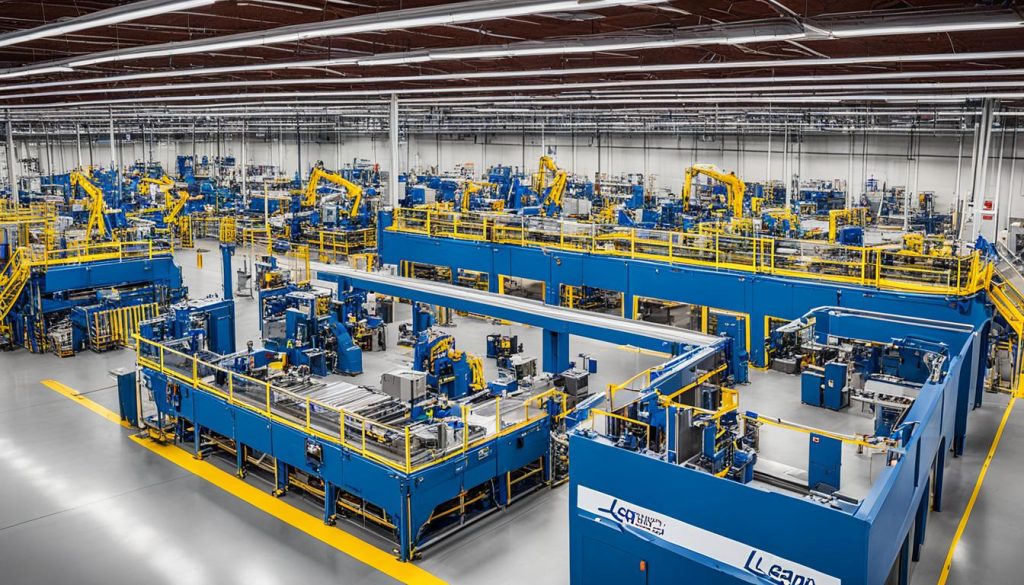
By studying and incorporating the lessons learned from these case studies, your organization can unlock the full potential of lean manufacturing and drive continuous improvement. Whether you’re in the automotive industry, healthcare, software development, or any other sector, the principles and success stories of lean manufacturing can provide invaluable guidance and inspiration for your own organizational transformation.
Lean Manufacturing and Continuous Improvement
Lean manufacturing is a continuous improvement process that prioritizes the pursuit of perfection. By embracing a culture of constant evolution, organizations can effectively address challenges, enhance processes, and eliminate waste. Continuous improvement techniques such as kaizen and the five whys provide valuable methodologies for identifying and resolving issues, ultimately driving progress within the organization.
Continuous improvement is a core principle of lean manufacturing, ensuring that organizations strive for excellence in a rapidly changing business environment. Kaizen, a Japanese term meaning “change for the better,” encourages small, incremental improvements that add up to significant advancements over time. Through kaizen, organizations empower their employees to challenge existing processes and cultivate a mindset of continuous learning and improvement.
The five whys technique, on the other hand, delves deeper into the root causes of problems by asking “why” repeatedly. This method helps organizations uncover the underlying issues that contribute to inefficiencies, enabling them to make targeted improvements and eliminate waste.
By implementing continuous improvement practices, organizations can unleash the full potential of lean manufacturing. This commitment to ongoing enhancement leads to increased operational efficiency, improved quality, reduced costs, and enhanced customer satisfaction. Constantly striving for perfection is what sets lean manufacturing apart and positions companies for long-term success in today’s competitive landscape.
“The most dangerous kind of waste is the waste we do not recognize.”
– Shigeo Shingo
The Importance of Kaizen in Lean Manufacturing
Kaizen, as a crucial component of lean manufacturing, plays a significant role in driving continuous improvement. It promotes a proactive approach to problem-solving, highlighting the notion that even the smallest changes can yield substantial benefits. With kaizen, employees at all levels are encouraged to contribute ideas and suggestions to improve processes and eliminate waste. This collaborative effort fosters a culture of continuous improvement, where everyone takes ownership of their work and strives for excellence.
The Five Whys Technique in Lean Manufacturing
The five whys technique is a powerful tool in lean manufacturing that helps organizations get to the root cause of problems and take preventive actions. By repeatedly asking “why” to identify the underlying causes of a problem, organizations can uncover hidden inefficiencies and eliminate waste. The five whys technique enables a deeper understanding of the relationships between symptoms and root causes, leading to more effective problem-solving and process improvement.
| Benefits of Continuous Improvement in Lean Manufacturing | Examples |
|---|---|
| Enhanced Operational Efficiency | Reduced setup times resulting in increased productivity |
| Improved Quality | Reduction in defects and rework, leading to higher customer satisfaction |
| Cost Reduction | Elimination of waste and optimized processes resulting in lower expenses |
| Increased Employee Engagement | Empowerment of employees to contribute ideas for improvement |
| Greater Customer Satisfaction | Delivery of high-quality products or services that meet customer needs |
By embracing continuous improvement as a central tenet of lean manufacturing, organizations can adapt to changing market demands, optimize processes, and deliver exceptional value to customers. The combination of kaizen, the five whys, and other continuous improvement practices empowers organizations to continually advance, stay ahead of the competition, and achieve long-term success.
Conclusion
Lean manufacturing offers a comprehensive methodology that empowers organizations to enhance efficiency, minimize waste, and optimize productivity. By implementing lean principles, you can not only deliver higher-quality products and services but also maximize customer value. The systematic approach of lean manufacturing tools, concepts, and techniques enables you to eliminate waste and continuously improve your processes.
With the right implementation and unwavering commitment, lean manufacturing can bring about significant benefits to your business. From reducing costs and streamlining operations to improving customer satisfaction and driving profitability, lean manufacturing equips you with the tools to thrive in today’s competitive landscape. It fosters a culture of continuous improvement and empowers your team to embrace new opportunities and challenges.
Lean manufacturing has revolutionized industries worldwide, spanning beyond traditional manufacturing. Companies in healthcare, software development, and the service sector have successfully implemented lean principles to enhance efficiency, reduce waste, and elevate the quality of their products and services. By adopting lean manufacturing, you position yourself at the forefront of industry best practices and join a community of forward-thinking organizations committed to excellence.
Embrace the power of lean manufacturing and unlock your organization’s potential for growth, innovation, and success. By implementing lean principles and leveraging the wealth of tools and methodologies available, you can build a foundation of efficiency, continuous improvement, and customer-centricity that sets you apart from the competition. Lean manufacturing offers an actionable framework to drive transformative change and propel your business toward a more prosperous future.