


Did you know that ceramics and glass are present in almost everything we interact with on a daily basis? From the buildings we live and work in to the kitchenware we use, these materials play a significant role in our lives. Their durability, functionality, and aesthetic appeal make them indispensable in various industries, such as construction, automotive, and sports.
Key Takeaways:
- Ceramics and glass are widely used in construction for building materials, insulation, and decorative elements.
- In the kitchen, ceramics and glass are commonly found in tableware, cookware, and kitchen appliances.
- In the bathroom, ceramics and glass are used for sanitary ware and vanity mirrors.
- Ceramics and glass are popular choices for home decor and lighting fixtures.
- These materials also find applications in outdoor spaces, such as gardens and driveways, as well as in the sports industry.
Applications in Construction
Ceramics and glass are indispensable materials in the construction industry. Their versatile properties and aesthetic appeal make them valuable for a wide range of applications, from building materials to insulation and decorative elements.
Ceramic tiles are extensively used for flooring, walls, and countertops. With their durability and beautiful designs, they enhance the visual appeal of residential and commercial spaces. Glass, on the other hand, provides natural lighting and protection from the elements through windows and skylights.
Insulation is an essential aspect of construction, and both ceramics and glass play significant roles. Glass fibers are widely used as insulation materials, providing thermal and acoustic benefits. Additionally, ceramic roof tiles offer insulation and efficient water drainage, ensuring the structural integrity of buildings.
Furthermore, ceramics and glass find applications beyond traditional building structures. They are employed in the construction of bridges, roads, and even power line poles. The strength and durability of these materials contribute to the longevity and safety of such infrastructure.
To give you a better understanding of the role ceramics and glass play in construction, here is a detailed table showcasing the different applications:
| Application | Materials |
|---|---|
| Flooring | Ceramic tiles |
| Walls | Ceramic tiles |
| Countertops | Ceramic tiles |
| Windows | Glass |
| Skylights | Glass |
| Insulation | Glass fibers |
| Roofing | Ceramic roof tiles |
| Bridges | Ceramics and glass |
| Roads | Ceramics and glass |
| Power line poles | Ceramics and glass |
As you can see, ceramics and glass are integral to the construction industry, providing strength, durability, and architectural beauty.
Ceramics and Glass in the Kitchen
The kitchen is a space where ceramics and glass are extensively used. These materials not only enhance the functionality of kitchenware but also contribute to the overall aesthetic appeal. Let’s explore how ceramics and glass play a significant role in your kitchen.
Porcelain Tableware and Cookware
Porcelain, a type of ceramic, is renowned for its elegance in tableware and cookware. It offers a pristine white appearance and a delicate, yet durable, composition. Porcelain plates, bowls, and serving dishes elevate your dining experience with their refined beauty.
Glassware for Elegance
Glass is a preferred choice for wine glasses, pitchers, and jars due to its clarity and elegance. The transparency of glass allows you to appreciate the color and texture of your beverages, enhancing the sensory experience.
Ovenproof Pyrex Glass
Pyrex glass is widely used for baking premium goods due to its ovenproof properties. It can withstand high temperatures without cracking or shattering, ensuring a safe and reliable baking experience.
Ceramic Coatings for Easy Maintenance
Ceramic coatings are often applied to ovens to make them scratch-free and easy to clean. These coatings provide a protective layer that resists stains, grease, and grime, making the cleaning process effortless.
Kitchen Appliances
Ceramic and glass materials are not limited to kitchenware. They also find application in kitchen appliances such as washing machines, dryers, and refrigerators. These materials contribute to the durability and functionality of these essential appliances.
| Ceramics in the Kitchen | Glass in the Kitchen |
|---|---|
| – Porcelain tableware and cookware | – Glassware for elegance |
| – Ceramic coatings for easy maintenance | – Ovenproof Pyrex glass |
| – Application in kitchen appliances |
As you can see, ceramics and glass are essential elements that add beauty, functionality, and convenience to your kitchen. Whether you’re enjoying a meal with porcelain tableware, pouring a refreshing drink from a glass pitcher, or baking delectable treats with ovenproof glass, these materials enhance your culinary experience. Moreover, their presence extends beyond kitchenware to include the appliances that make your daily cooking endeavors seamless.
Next, let’s explore how ceramics and glass find their place in another vital area of the home: the bathroom.
Ceramics and Glass in the Bathroom
In the bathroom, ceramics and glass play a vital role in creating a functional and visually appealing space. They are commonly used for sanitary ware and contribute to the overall cleanliness and elegance of the bathroom environment.
Ceramic Sanitary Ware
White clay-based ceramic materials are extensively used for various bathroom fixtures, including sinks, toilets, and bathtub enclosures. These ceramics provide durability, resistance to water, and easy maintenance, making them an ideal choice for the bathroom.
Glass Vanity Mirrors
Vanity mirrors, essential for grooming and personal care, are often made from flat glass panels. The clear and reflective properties of glass provide a sleek and modern aesthetic to the bathroom. Large vanity mirrors enhance the sense of space and natural light in the room.
Ceramic Coatings
Ceramic coatings are applied to bathroom surfaces to achieve scratch-resistant and stain-resistant properties. These coatings enhance the longevity and cleanliness of bathroom fixtures, such as counters, sinks, and tiles, by providing a protective barrier against daily wear and tear.
By combining ceramics and glass in the bathroom, you can create a harmonious and functional space that is both visually appealing and easy to maintain.
| Ceramics | Glass |
|---|---|
| White clay-based materials | Flat glass panels |
| Sinks | Vanity mirrors |
| Toilets | |
| Bathtub fixtures |
Ceramics and Glass in Decor and Lighting
Ceramics and glass are popular choices for enhancing the aesthetic appeal of your home decor and lighting fixtures. Whether you want to add elegance, artistic flair, or a touch of sophistication to your living space, ceramics and glass can help you achieve the desired effect.
One way to incorporate ceramics and glass into your decor is through beautiful ceramic sculptures and glass art pieces. These unique creations not only showcase your personal style but also serve as conversation pieces that elevate the ambiance of any room.
A practical and stylish use of ceramics and glass is in the creation of picture frames. Ceramic substrates provide a sturdy base for displaying your cherished photographs, while glass layers protect the pictures from dust and damage, preserving them for years to come.
When it comes to lighting, ceramics and glass play pivotal roles. Lighting fixtures often incorporate glass bulbs and shades, allowing the light to shine through and create a warm and inviting ambiance. Lamp bases can be crafted from porcelain or earthenware, adding a touch of elegance to the overall design.
Now, let’s take a closer look at the various applications of ceramics and glass in decor and lighting:
“Ceramics and glass are versatile materials that add beauty and functionality to your home decor and lighting fixtures. They bring a unique charm and elegance to any space, making them a popular choice among homeowners and interior designers.”
Applications of Ceramics and Glass in Decor and Lighting
| Applications | Examples |
|---|---|
| Ceramic Sculptures | |
| Glass Art Pieces | |
| Picture Frames | |
| Lighting Fixtures | |
| Lamp Bases | 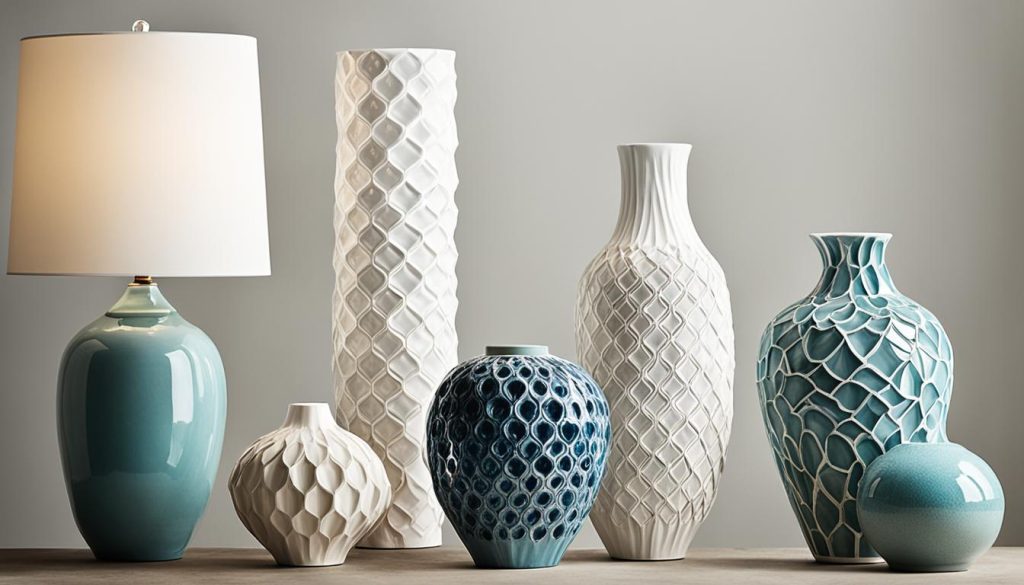 |
As you can see, ceramics and glass offer a wide range of applications in decor and lighting. They add a touch of elegance, style, and functionality to your living space, making it more inviting and visually appealing.
So, whether you’re looking to enhance the beauty of your home with ceramic sculptures, showcase stunning glass art pieces, display your cherished memories in elegant picture frames, or create a warm and inviting ambiance with lighting fixtures and lamp bases, ceramics and glass provide the perfect solution.
Ceramics and Glass Outdoors
When it comes to ceramics and glass, their applications are not limited to indoor spaces. Outdoors, these versatile materials offer an array of possibilities to enhance the beauty and functionality of various settings. From gardens to driveways, ceramics and glass can be found in many outdoor elements.
Enhancing Gardens
Ceramic flower pots, statuettes, and bird baths are excellent additions to any garden. These outdoor accessories not only add a touch of elegance but also provide a durable and weather-resistant option for showcasing plants and attracting birds. The vibrant colors and intricate designs of ceramic pieces can create a focal point and add visual interest to your garden.
“Ceramic flower pots and statuettes bring a touch of sophistication to any outdoor space, effortlessly combining beauty and durability.”
Another way to incorporate ceramics and glass into outdoor design is through the use of mosaics and glass tiles. These materials offer versatility and durability, making them suitable for creating vibrant and eye-catching patterns on walls, fountains, or other outdoor structures. The reflective properties of glass tiles can also add a touch of sparkle to your outdoor oasis.
Driveways with Character
Bricks made from ceramics can give your driveway a rustic and charming appearance. Ceramic bricks are known for their durability and resistance to weather conditions, making them an ideal choice for creating a welcoming entrance to your home. The variety of colors, shapes, and sizes available allows for endless possibilities, letting you personalize the look of your driveway.
Application in Automotive and Mechanical Components
The use of glass extends beyond decorative purposes in outdoor settings. Glass is commonly employed in automotive windows and various mechanical components due to its transparency, strength, and resistance to environmental factors. Whether it’s in the windshield of your car or as a protective cover for electronic displays, glass plays a crucial role in ensuring visibility and durability in outdoor situations.
| Applications | Examples |
|---|---|
| Gardens | Ceramic flower pots, statuettes, bird baths |
| Outdoor Design | Ceramic mosaics, glass tiles |
| Driveways | Ceramic bricks |
| Automotive | Glass windows, protective covers |
Ceramics and Glass in Sports
Ceramics and glass materials are widely used in the sports industry. These high-performance materials offer strength, durability, and improved performance to athletes in various sports.
One example of their application is in golf, where ceramic putters are favored for their precision and control. The lightweight nature of ceramics allows for better swing speed and accuracy on the greens.
Similarly, ceramics and composites are utilized in skiing and snowboarding equipment. Smart skis incorporate piezoelectric materials that generate electricity during movement, enhancing stability and control for the skier. Glass-carbon laminates are used in snowboards to provide a perfect balance of stiffness, responsiveness, and shock absorption.
In car racing, ceramic brakes are highly sought after for their exceptional braking performance. These brakes offer superior heat resistance, reducing brake fade and ensuring consistent stopping power even under demanding conditions.
Ceramics and glass also play a significant role in biking. Lightweight ceramic components are used in bicycles to enhance speed and agility. Additionally, glass fibers are incorporated into bike frames to improve strength and stability.
The Benefits of Ceramics and Glass in Sports:
- Lightweight construction for enhanced performance
- Superior durability and strength
- Improved precision and control
- Resistance to heat and shock
“Ceramics and glass materials have revolutionized the sports industry, enabling athletes to push their limits and achieve remarkable feats.”
— Sports Equipment Magazine
Whether it’s on the golf course, the slopes, the racetrack, or the cycling trails, ceramics and glass continue to advance sports equipment, providing athletes with the tools they need to excel. These innovative materials contribute to faster times, improved accuracy, and a safer sporting experience.
| Sport | Application |
|---|---|
| Golf | Ceramic putters for precision and control |
| Skiing | Piezoelectric materials for smart skis |
| Snowboarding | Glass-carbon laminates for enhanced performance |
| Car racing | Ceramic brakes for exceptional stopping power |
| Biking | Lightweight ceramic components for speed and agility |
Glass-Ceramics
Glass-ceramics are a unique class of polycrystalline materials that combine the properties of both glass and ceramics. These materials are created through a controlled crystallization process of base glass, resulting in the dispersion of small crystals throughout the material.
One of the key advantages of glass-ceramics is their high strength and toughness, making them ideal for applications that require durability and resistance to breakage. Additionally, glass-ceramics exhibit excellent thermal stability, allowing them to withstand extreme temperatures without deformation or degradation.
Another noteworthy characteristic of glass-ceramics is their low thermal expansion coefficient, which means they have minimal dimensional changes with temperature fluctuations. This property is particularly valuable in high-precision applications where dimensional stability is critical.
Furthermore, glass-ceramics are known for their exceptional chemical durability and resistance to corrosion. This makes them suitable for use in environments where exposure to harsh chemicals is common, such as in laboratory equipment or industrial settings.
Glass-ceramics find applications in various fields, including:
- Sealing applications: Glass-ceramics are used in hermetic sealing applications due to their excellent mechanical strength and ability to maintain a tight seal, even under high-pressure conditions.
- Cookware: Glass-ceramic materials are utilized in cookware for their heat resistance, which allows them to withstand high temperatures without cracking or warping.
- High-temperature environments: Glass-ceramics are employed in environments where extreme temperatures are present, such as in furnaces, kilns, and aerospace applications.
The unique combination of glass and ceramic properties in glass-ceramics makes them versatile materials with a wide range of applications. Their exceptional strength, thermal stability, low thermal expansion, and chemical durability make them a valuable choice in industries that require high-performance materials.
Applications of Glass-Ceramics
| Application | Description |
|---|---|
| Sealing | Used for hermetic sealing in high-pressure applications |
| Cookware | Heat-resistant materials for cookware |
| High-temperature environments | Materials for furnaces, kilns, and aerospace applications |
Ceramics and Glass in Industrial Applications
Ceramics and glass are invaluable materials that find extensive use in various industrial applications. They offer unique properties and capabilities that make them indispensable in sectors such as metallurgical, chemical, and energy production.
Refractories: Withstanding High Temperatures
Refractories are a prime example of ceramics and glass being utilized in industrial settings. These specialized materials have the ability to withstand extreme temperatures, making them essential for applications requiring high heat resistance.
- Refractories serve as linings for furnaces, ensuring efficient heat retention and containment.
- They are employed in the construction of pipes and vessels used in material processing, providing durability and thermal insulation.
Catalysts and Catalyst Carriers: Driving Chemical Processes
In the petroleum refining and chemical processing industries, ceramics play a vital role as catalysts and catalyst carriers. These materials facilitate crucial chemical reactions that are integral to production processes.
Chemical reactions in petroleum refining and chemical processing heavily rely on catalysts made from ceramics. They enable the transformation of raw materials into valuable products.
Filtration and Separation Processes
Ceramics are highly effective in filtration and separation processes utilized in various industries. Their unique porous structure allows for selective filtration and purification of liquids and gases.
- Ceramic membranes and filters provide a reliable means of separating solids from liquids or gases.
- They find application in wastewater treatment, pharmaceutical manufacturing, and water purification systems.
Wear and Corrosion-Resistant Parts
In manufacturing processes, the durability of components is of utmost importance. Ceramics are incorporated in the production of wear and corrosion-resistant parts that can withstand harsh operating conditions.
Ceramic parts and coatings are resistant to wear and corrosion, making them ideal for use in machinery and equipment subjected to extreme environments.
Table: Applications of Ceramics and Glass in Industrial Settings
| Industry | Applications |
|---|---|
| Metallurgical | Refractories for furnaces, pipes, and vessels |
| Chemical | Catalysts and catalyst carriers |
| Energy Production | High-temperature insulation materials |
| Manufacturing | Wear and corrosion-resistant parts |
| Pharmaceutical | Filtration and separation processes |
The versatility of ceramics and glass in industrial applications continues to drive innovation and improve processes across various sectors. Their unique properties and wide range of applications make them essential materials in our modern industrial landscape.
Glass in Manufacturing and Instrumentation
Glass serves various purposes in manufacturing and instrumentation. It is commonly used for protective equipment, such as machinery covers and eyeglasses. Glass panels and lenses are essential components in instrumentation and manufacturing equipment, providing clarity and protection. Glass materials are also used for inspection systems and other specialized manufacturing equipment.
Whether it’s ensuring the safety of workers or optimizing the precision and accuracy of industrial processes, glass plays a vital role. Let’s take a closer look at some of the key applications and advantages of glass in manufacturing and instrumentation:
Protective Equipment
Glass is widely used in the production of protective equipment for manufacturing and industrial settings. Machinery covers made from tempered glass provide a transparent barrier against moving parts while allowing operators to monitor processes. Safety glasses made with impact-resistant glass protect workers’ eyes from debris and hazardous materials encountered in manufacturing environments.
Instrumentation Components
Glass panels and lenses are critical components in various types of instrumentation. They provide optical clarity, allowing for accurate readings and measurements. Glass lenses and prisms are used in cameras, sensors, and optical instruments to focus light and capture precise images. Glass tubes and cuvettes are essential for spectrophotometers and other analytical instruments in scientific research and quality control processes.
Inspection Systems
Glass materials play an important role in inspection systems used in manufacturing processes. Glass windows and transparent enclosures allow operators to visually inspect products and monitor production lines. Glass mirrors and lenses are used in imaging systems that enable detailed inspections, flaw detection, and quality control in industries like automotive manufacturing, electronics, and precision engineering.
Specialized Manufacturing Equipment
In specialized manufacturing processes, glass is indispensable. Glass materials with specific properties, such as high temperature resistance and chemical inertness, are used in equipment like glass-melting furnaces and reactors. Glass molds are utilized for shaping and forming various products, including precision optics, electronic components, and glass containers. Glass substrates serve as a foundation for microelectronic circuits and sensors, enabling advanced manufacturing techniques.
By harnessing the unique properties of glass, manufacturers and researchers can improve safety, precision, and efficiency in various industrial applications. The use of glass in manufacturing and instrumentation showcases its versatility and adaptability across different sectors.
Conclusion
Ceramics and glass are not just ordinary materials; they are essential elements that surround us in our everyday lives and serve a multitude of purposes. Whether it’s the durable ceramic tiles in our homes, the glass windows that allow natural light to flood our spaces, or the delicate porcelain tableware in our kitchens, ceramics and glass offer both functionality and aesthetic appeal.
Moreover, these versatile materials go beyond our homes and find applications in various industries. From construction to industrial manufacturing, ceramics and glass provide strength, durability, and protection. In the construction industry, they are used as building materials, insulation, and decorative elements, while in industrial applications, ceramics and glass serve as refractories, catalysts, and wear-resistant parts.
The constant innovation and development in ceramics and glass science and technology continue to expand their applications and push the boundaries of what is possible. By joining the American Ceramic Society, individuals can become part of a global community dedicated to advancing these amazing materials. Together, we can unlock their full potential and shape a future where ceramics and glass play an even more significant role in our modern world.