
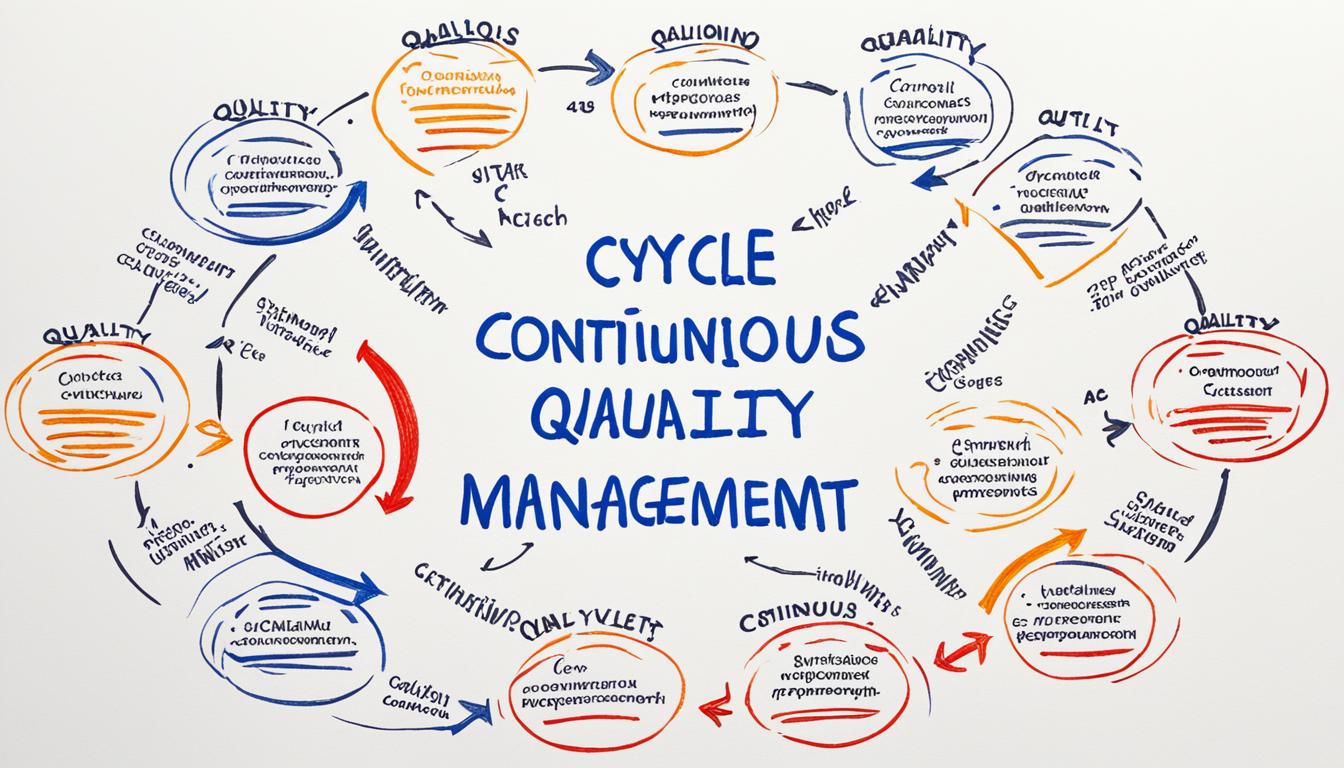
Continuous improvement is a fundamental principle of quality management that focuses on constantly enhancing products, services, and processes through incremental and breakthrough improvements. It is driven by the goal of never being satisfied with the status quo and always striving for better. Quality gurus like Dr. W. Edwards Deming have emphasized the importance of continuous improvement in achieving high-quality results.
The Plan-Do-Study-Act (PDSA) cycle, also known as the Deming Wheel, provides a systematic approach for continuous improvement. By implementing continuous improvement practices, organizations can increase efficiency, improve customer satisfaction, and gain a competitive advantage in the market.
Key Takeaways:
- Continuous improvement is a fundamental principle of quality management
- The Plan-Do-Study-Act (PDSA) cycle provides a systematic approach for continuous improvement
- Implementing continuous improvement practices can lead to increased efficiency and improved customer satisfaction
- Continuous improvement is essential for organizations to stay competitive in the market
- Quality gurus like Dr. W. Edwards Deming have emphasized the importance of continuous improvement
Understanding Continuous Improvement
Continuous improvement, also referred to as continual improvement or Kaizen, is an ongoing process of making small incremental changes to products, services, or processes. These changes can be either incremental, where improvements are made over time, or breakthrough, where significant improvements are made all at once.
The Plan-Do-Study-Act (PDSA) cycle, introduced by Dr. Deming, provides a framework for continuous improvement. The cycle involves planning, implementing, studying outcomes, and acting based on the learning generated. Continuous improvement is a key principle in quality management and is essential for organizations to stay competitive and meet customer expectations.
Benefits of Continuous Improvement:
| Benefits | Description |
|---|---|
| Increased Efficiency | Continuous improvement leads to streamlined processes, reducing waste and improving productivity. |
| Improved Employee Engagement | By involving employees in the improvement process, organizations foster an engaged workforce committed to achieving excellence. |
| Reduced Costs | Identifying and eliminating inefficiencies helps organizations optimize resource utilization and minimize expenses. |
| Enhanced Customer Satisfaction | Continuous improvement ensures that products and services consistently meet or exceed customer expectations. |
| Increased Innovation | By fostering a culture of continuous improvement, organizations encourage creative thinking and the exploration of new ideas. |
Continuous Improvement Methods
Implementing continuous improvement requires the use of various methods and frameworks that cater to different organizational needs. These methods offer unique approaches to achieve ongoing enhancements and can be adapted to different industries and contexts. Let’s explore some of the most widely recognized continuous improvement methods:
Lean Methodology
The Lean methodology focuses on eliminating waste and improving efficiency through process streamlining. By identifying and eliminating non-value-adding activities, organizations can optimize their operations and enhance overall productivity. Lean principles, such as just-in-time production and continuous flow, help organizations deliver value to customers more effectively. The Lean methodology’s emphasis on continuous improvement aligns with the pursuit of operational excellence and cost reduction.
Kanban Method
The Kanban method helps visualize and optimize workflow by breaking down work into smaller tasks and tracking progress. The use of Kanban boards, which display work items and their current status, allows teams to visualize the flow of work and identify bottlenecks. By limiting work in progress and focusing on completing tasks, organizations can achieve higher productivity and improve customer satisfaction. The Kanban method encourages continuous improvement by providing a clear framework for identifying and resolving issues in the workflow.
Six Sigma
Six Sigma is a statistical framework that aims to reduce defects in processes to achieve near-perfection. It focuses on data-driven analysis and process improvement methodologies. Six Sigma projects follow a structured approach known as DMAIC (Define, Measure, Analyze, Improve, Control) to identify and eliminate defects, enhancing operational performance and customer satisfaction. By using statistical tools and techniques, organizations can optimize processes and achieve consistent high-quality outcomes.
Total Quality Management (TQM)
Total Quality Management is a comprehensive approach to quality that emphasizes the involvement of all employees in the improvement process. TQM ensures that products or services consistently meet or exceed customer expectations by systematically identifying and addressing quality issues. It incorporates continuous improvement as a core principle, enabling organizations to enhance customer satisfaction and loyalty. TQM promotes a customer-centered culture and encourages employee engagement to drive excellence in quality management.
Agile Methodology
The Agile methodology is commonly used in software development and emphasizes iterative development and constant feedback. Agile practices, such as Scrum and Kanban, enable teams to adapt to changing requirements and deliver high-quality software in a timely manner. By embracing flexibility, collaboration, and continuous improvement, Agile enables organizations to respond to market demands effectively. The Agile mindset encourages teams to learn from each iteration, making continuous enhancements a natural part of the development process.
Each of these continuous improvement methods offers valuable principles and practices that organizations can leverage to achieve their quality and performance objectives. The key lies in selecting and adapting the most suitable approach for specific organizational needs, leveraging the strengths of each method to drive sustainable improvement.
| Continuous Improvement Method | Description |
|---|---|
| Lean Methodology | Focuses on eliminating waste and improving efficiency through process streamlining. |
| Kanban Method | Visualizes and optimizes workflow by breaking down work into smaller tasks and tracking progress. |
| Six Sigma | Reduces defects in processes to achieve near-perfection through statistical analysis and improvement methodologies. |
| Total Quality Management (TQM) | Ensures products or services meet or exceed customer expectations by systematically identifying and addressing quality issues. |
| Agile Methodology | Emphasizes iterative development and constant feedback in software development projects. |
Benefits of Continuous Improvement
Continuous improvement offers a wide range of benefits for organizations. By consistently identifying and addressing areas for improvement, organizations can achieve increased efficiency, resulting in higher productivity and optimized operations. Improved employee engagement and satisfaction are other valuable outcomes of continuous improvement practices.
“Continuous improvement is not just about implementing changes; it’s also about empowering employees and encouraging their active participation in the process.”
When employees feel that their voices are heard, and their suggestions make a difference, they become more engaged and motivated in their work. This engagement fuels their commitment to delivering high-quality work, driving overall organizational success.
In addition to employee engagement, continuous improvement helps organizations reduce waste and minimize inefficiencies. By optimizing processes, organizations can eliminate unnecessary steps, reduce errors, and save valuable resources. This, in turn, leads to reduced costs and enhanced profitability.
Customer satisfaction is another critical benefit of continuous improvement. By consistently striving to deliver products or services that meet or exceed customer expectations, organizations can enhance customer satisfaction and build long-term customer loyalty.
Continuous improvement fosters a culture of innovation within organizations. By constantly exploring new ways to improve products, services, and processes, organizations can stay ahead of the competition and drive increased innovation. This ongoing pursuit of improvement encourages creativity and drives continuous growth and competitiveness.
Overall, continuous improvement is a powerful approach that enables organizations to achieve greater efficiency, improve employee engagement, reduce waste, cut costs, enhance customer satisfaction, and foster innovation.
| Benefits of Continuous Improvement |
|---|
| Increased efficiency |
| Improved employee engagement |
| Reduced waste |
| Reduced costs |
| Enhanced customer satisfaction |
| Increased innovation |
Implementing Continuous Improvement
Implementing continuous improvement requires a systematic approach. By following established practices and utilizing effective strategies, organizations can drive positive change and optimize their quality management processes. The key elements of implementing continuous improvement include:
- Feedback Loops: Establishing feedback loops enables organizations to gather valuable insights from customers, employees, and stakeholders. This feedback helps identify areas for improvement and informs decision-making processes.
- Regular Audits: Regular audits of the quality management system are essential to identify weaknesses and opportunities for enhancement. These audits ensure that organizations remain proactive in addressing potential issues that may hinder continuous improvement efforts.
- Quality Tools: Utilizing quality tools such as the Plan-Do-Check-Act (PDCA) cycle, Six Sigma, and Root Cause Analysis can help organizations identify problems, implement effective solutions, and monitor the results of improvement initiatives.
- Employee Training: Providing comprehensive training to employees equips them with the necessary skills to identify and suggest areas for improvement. Investing in employee development fosters a culture of continuous improvement throughout the organization.
- Review and Adjustment: Regularly reviewing and adjusting the quality management system based on the changing internal and external environment is essential for sustained improvement. This ensures that organizations remain agile and adaptable to meet evolving customer needs and market demands.
By implementing these practices, organizations can create a culture of continuous improvement that drives positive change and maximizes the effectiveness of their quality management systems.
Continuous Improvement Framework: The Plan-Do-Check-Act (PDCA) Cycle
The PDCA cycle is a widely recognized framework for continuous improvement. It consists of four steps:
- Plan: Define improvement goals, identify areas for improvement, and develop action plans to achieve those goals.
- Do: Implement the planned actions on a small scale to test their effectiveness and feasibility.
- Check: Evaluate the results of the implemented actions and compare them against the established goals and metrics. Analyze the data to gain insights into the effectiveness of the improvements.
- Act: Based on the findings from the previous steps, make necessary adjustments and modifications to the improvement plan. Scale up the successful changes and refine the approach to achieve continuous improvement.
Importance of Continual Improvement in Quality Management
Continual improvement plays a critical role in quality management as it ensures that an organization meets customer expectations, stays ahead of competitors, maintains regulatory compliance, and improves operational efficiency. In a rapidly changing market, customer demands and expectations evolve, and continuous improvement enables organizations to adapt and refine their offerings. By consistently fine-tuning processes and products, organizations can differentiate themselves and maintain a competitive edge. Continual improvement also helps organizations remain compliant with regulations and optimize resource utilization, ultimately leading to increased profitability. Maintaining high-quality standards through continual improvement is essential for customer satisfaction and loyalty.

- Continuous improvement ensures that products and services align with the evolving needs and demands of customers.
- By actively listening to customer feedback and making necessary adjustments, organizations can enhance the value they provide to their customers.
Staying ahead of competitors:
- Continuous improvement enables organizations to stay ahead of competitors by constantly exploring new ways to improve efficiency and effectiveness.
- By embracing innovative ideas and implementing them in a timely manner, organizations can gain a competitive advantage in the market.
Regulatory compliance:
- Continuous improvement helps organizations ensure compliance with industry-specific regulations and standards.
- By regularly reviewing and adjusting processes, organizations can address any compliance gaps and mitigate risks.
Operational efficiency:
- Continuous improvement aims to eliminate waste, streamline processes, and optimize resource utilization.
- By identifying and addressing inefficiencies, organizations can achieve higher levels of productivity and operational excellence.
Quality maintenance:
- Continuous improvement practices support the maintenance of high-quality standards throughout the organization.
- By consistently monitoring and improving quality processes, organizations can enhance customer satisfaction and loyalty.
Continuous improvement is the key to unlocking the full potential of a quality management system. By embracing a culture of continual improvement, organizations can meet customer expectations, outperform competitors, maintain compliance, improve efficiency, and ensure consistent quality.
Challenges and Considerations in Continuous Improvement
Implementing continuous improvement initiatives may face challenges that need to be carefully addressed to ensure successful implementation. Overcoming resistance to change, managing costs, ensuring sustainability, and balancing short-term improvements with long-term benefits are critical considerations for organizations.
Resistance to Change
Resistance to change is a common challenge when implementing continuous improvement initiatives. Employees may be resistant to new processes, technologies, or ways of working. Effective communication and active employee engagement are key to overcoming this resistance. Organizations should clearly communicate the reasons for change, address concerns, and involve employees in the decision-making process. By creating a supportive environment and demonstrating the benefits of change, resistance can be minimized.
Costs
The implementation of continuous improvement strategies may involve costs that organizations need to carefully evaluate. Investing in new technologies, training programs, or process enhancements can incur financial expenses. It is essential to conduct a cost-benefit analysis to assess the potential return on investment. Organizations should prioritize improvement initiatives based on their impact on efficiency, productivity, and customer satisfaction.
Sustainability
Ensuring the sustainability of changes is crucial to maintain the benefits of continuous improvement in the long run. Changes should be evaluated not only based on their immediate impact but also considering long-term sustainability. Factors such as resource availability, technological advancements, and organizational capabilities should be taken into account. Continuous improvement initiatives should be designed to withstand future changes and remain effective over time.
Balancing Changes and Long-Term Benefits
Organizations must strike a balance between implementing immediate improvements and focusing on long-term benefits. While it is important to address immediate needs and deliver quick wins, the long-term vision should not be compromised. Continuous improvement should be aligned with the organization’s strategic goals and long-term objectives. By carefully managing changes and considering their impact on future outcomes, organizations can ensure that they derive maximum benefit from their improvement efforts.
| Challenges | Considerations |
|---|---|
| Resistance to Change | Effective communication and employee engagement |
| Costs | Conducting cost-benefit analysis |
| Sustainability | Evaluating long-term impacts and resource availability |
| Balancing Changes and Long-Term Benefits | Aligning initiatives with strategic objectives |
Addressing these challenges and considerations is crucial for successful implementation of continuous improvement initiatives. By effectively managing resistance to change, evaluating costs, ensuring sustainability, and balancing short-term improvements with long-term benefits, organizations can unlock the full potential of continuous improvement and drive continuous growth and success.
Continuous Improvement in a Quality Management System
Continuous improvement is an essential aspect of a quality management system (QMS). It involves ongoing efforts to refine and enhance the effectiveness, efficiency, and flexibility of the entire QMS. By prioritizing continuous improvement, organizations ensure that quality remains at the core of their operations and is not simply a one-time achievement.
One of the key benefits of continuous improvement is its ability to foster a culture of excellence in quality management. By consistently seeking opportunities for refinement, organizations can maintain high standards and strive for excellence in all aspects of their products or services. This commitment to ongoing refinement sets the stage for achieving and sustaining a competitive edge in the market.
Delivering quality consistency is another important outcome of implementing continuous improvement in a QMS. By continuously assessing and improving processes, organizations can ensure that their products or services consistently meet or exceed customer expectations. This, in turn, builds trust and loyalty among customers, establishing a strong reputation for delivering high-quality outcomes.
Through continuous improvement, organizations can identify areas of improvement and implement necessary changes to optimize their quality management processes. This commitment to ongoing refinement plays a critical role in promoting operational efficiency and effectiveness. By streamlining and optimizing processes, organizations can reduce errors, waste, and inefficiencies, leading to improved productivity and cost savings.
The implementation of continuous improvement in a QMS requires a systematic approach. It involves an ongoing cycle of monitoring, analysis, planning, implementation, and review. By utilizing tools and techniques such as process audits, performance indicators, and quality control charts, organizations can track progress and identify areas for improvement.
The Benefits of Continuous Improvement in a Quality Management System
The benefits of continuous improvement in a QMS are numerous and impactful. Here are some key advantages:
- Enhanced Quality: Continuous improvement ensures that quality remains a priority and that processes are constantly refined to deliver the highest standards.
- Reduced Costs: By eliminating wasteful practices and streamlining processes, continuous improvement helps organizations reduce costs and improve profitability.
- Increased Employee Satisfaction: Continuous improvement empowers employees by involving them in the process and implementing their suggestions. This leads to increased job satisfaction and engagement.
- Customer Trust and Loyalty: Delivering consistent high-quality products or services through continuous improvement builds trust and fosters customer loyalty.
Implementing continuous improvement in a quality management system is essential for organizations that aim to excel in delivering consistent, high-quality outcomes. By fostering a culture of ongoing refinement and prioritizing quality consistency, organizations can achieve excellence, improve efficiency, and meet or exceed customer expectations.
Benefits of Continuous Improvement in a Quality Management System
| Benefits | Description |
|---|---|
| Enhanced Quality | Continuous improvement ensures that quality remains a priority and that processes are constantly refined to deliver the highest standards. |
| Reduced Costs | By eliminating wasteful practices and streamlining processes, continuous improvement helps organizations reduce costs and improve profitability. |
| Increased Employee Satisfaction | Continuous improvement empowers employees by involving them in the process and implementing their suggestions. This leads to increased job satisfaction and engagement. |
| Customer Trust and Loyalty | Delivering consistent high-quality products or services through continuous improvement builds trust and fosters customer loyalty. |
Benefits of Continuous Improvement in a Quality Management System
Implementing continuous improvement in a quality management system offers several benefits. One of the primary goals of a QMS is to enhance the quality and ensure that the highest standards are consistently maintained. Continuous improvement practices play a crucial role in achieving this goal by constantly identifying and eliminating inefficiencies, bottlenecks, and defects in processes and products.
This relentless pursuit of quality not only enhances the overall output but also reduces costs and improves profitability. By streamlining processes, optimizing resources, and eliminating waste, organizations can significantly reduce operational expenses. This, in turn, allows them to pass on these cost savings to the customers, increasing their affordability and competitiveness in the market.
Continuous improvement also leads to increased employee satisfaction and engagement. When employees see their feedback and suggestions being implemented and witness the positive impact on the organization, their motivation and morale improve. They feel valued and become more committed to the organization’s success.
Furthermore, organizations that consistently strive for better quality build a reputation for reliability, trustworthiness, and customer satisfaction. This reputation fosters customer trust and loyalty, as customers come to rely on the organization’s products or services for their needs. As a result, loyal customers are more likely to repurchase and recommend the organization to others, creating a sustainable customer base and a competitive advantage in the market.
An Example of Continuous Improvement in a Quality Management System
“By implementing a continuous improvement program, XYZ Company achieved a 30% reduction in defects and a 20% increase in customer satisfaction within six months. This initiative involved regularly monitoring and analyzing customer feedback, identifying quality improvement opportunities, and implementing corrective actions. The organization’s commitment to continuously improving its products and services not only enhanced the overall quality but also cultivated a loyal customer base, leading to increased profitability and long-term success.”
Overall, continuous improvement in a quality management system brings about enhanced quality, reduced costs, increased employee satisfaction, and customer trust and loyalty. By leveraging these benefits, organizations can establish themselves as industry leaders and create long-term value for both internal and external stakeholders.
Conclusion
Continuous improvement is a critical aspect of quality management that empowers organizations to enhance efficiency, boost performance, and drive customer satisfaction. By continuously seeking opportunities to improve products, services, and processes, organizations can stay ahead of the competition and meet the evolving expectations of their customers.
Implementing continuous improvement methods and frameworks, such as Lean, Six Sigma, and Agile, enables organizations to streamline processes, eliminate waste, and optimize resource utilization. These methodologies provide structured approaches to identify and address areas for improvement, leading to increased efficiency and effectiveness.
The benefits of continuous improvement are substantial. By embracing a culture of continuous improvement, organizations can achieve enhanced productivity, improved employee engagement and satisfaction, reduced costs, and enhanced customer satisfaction. Additionally, a commitment to continuous improvement fosters a culture of innovation and allows organizations to adapt to evolving market demands.
In summary, continuous improvement is an essential component of quality management, enabling organizations to enhance efficiency, boost performance, and ultimately drive customer satisfaction. By implementing continuous improvement practices, organizations can continuously refine their processes, products, and services, ensuring they maintain a competitive edge in today’s ever-changing business landscape.